Grants Pass
Living in Grants Pass: what locals know
Housing tradeoffs, property taxes, downtown, the event calendar, getting around, and the difference between city and rural living.
From the outside, Grants Pass looks like a classic Oregon river town along Interstate 5—famous for the Rogue River, historic brick storefronts, and easy access to the redwoods and coast. Once you actually live here, though, you discover a nuanced community where neighborhood boundaries, tax districts, seasonal rhythms, and city-versus-county tradeoffs shape your daily routine.
Here is an honest, ground-level look at what locals know about living in Grants Pass.
Housing Tradeoffs: Choosing Your Pocket of Town
Grants Pass isn't one uniform market. Where you buy determines your commute, lot size, utility bills, and even your fire protection.
- Historic Downtown & Central Grants Pass: Tree-lined streets near Riverside Park and the Historic District feature Craftsman bungalows, mid-century ranches, and walkable access to coffee shops, restaurants, and groceries. Tradeoff: smaller lots, older plumbing/electrical systems to inspect, and street parking on busy event weekends.
- Redwood & Southwest Grants Pass: Popular for established neighborhoods, larger residential lots, and quick access to Reinhart Volunteer Park, Allen Creek, and Highway 199 toward the coast. Note that parts of the Redwood corridor cross between city limits and unincorporated county pockets.
- Fruitdale & Southeast: Convenient to medical corridors, shopping, and I-5, with a mix of 1970s–2000s homes and newer subdivisions.
- North Valley, Merlin & Hugo: Just north of town, you shift quickly into 1-to-5+ acre rural residential parcels, shops, and mountain views—ideal for RVs, boats, and hobbies, with well/septic maintenance in place of city utilities.
- Murphy & Applegate Corridor: South along Highway 238, life slows down into riverfront pockets, vineyards, and valley-floor acreage heading toward Jacksonville.
With Grants Pass median sale prices sitting around $384,000 (Redfin) and average home values near $397,758 (Zillow) as of November 2026, buyers generally get more square footage or land for the dollar than in nearby Ashland (~$520,000 median per Cal's Moving).
City vs. Rural Living: The Everyday Tradeoffs
Many buyers arrive wanting "five acres close to town," only to realize that in-town convenience and rural independence carry very different day-to-day responsibilities:
| Factor | Inside Grants Pass City Limits | Unincorporated Josephine County (Rural) |
|---|---|---|
| Water & Sewer | Municipal water & sewer; predictable monthly utility bill | Private well & septic system; owner handles testing, pumps, and maintenance |
| Fire Protection | City fire department & pressurized hydrants funded by city taxes | Subscription membership via Rural Metro Fire or Mid Rogue Fire District |
| Internet & Cell | Cable and fiber options in most neighborhoods | Cable/fiber near highways; fixed wireless or Starlink in canyons & valleys |
| Trash & Snow/Storm Prep | Curbside pickup; paved city streets | Hauling or private rural pickup; gravel roads, fallen trees, & generator prep |
| Land Flexibility | City zoning, HOA rules (in newer subdivisions), & parking limits | Room for shops, RVs, chickens, gardens, & fewer immediate neighbors |
How Property Taxes Work in Grants Pass
Oregon's property tax system is governed by Measure 5 and Measure 50, which limit permanent tax district rates and cap annual Assessed Value (AV) growth at 3% per year unless major improvements are added (League of Oregon Cities).
What locals pay attention to:
- No Reset on Purchase: Unlike California, buying a home in Grants Pass does not reset its Assessed Value to your purchase price (Josephine County Assessor).
- City vs. County Rate Differences: Properties inside Grants Pass city limits pay city operating taxes (covering municipal police, fire, and parks) on top of county, school, and library districts, whereas rural county parcels have lower base tax rates but require separate out-of-pocket spending for fire membership, well/septic upkeep, and road maintenance.
- Verify by Parcel: Always look up the exact tax history on Josephine County Public Access rather than relying on rules of thumb.
Downtown Amenities: Where Locals Actually Spend Time
Downtown Grants Pass has an active, locally owned core anchored by Historic Downtown Grants Pass and Main Street Grants Pass. Instead of big-box chains, G Street and 6th Street are lined with independent boutiques, vintage shops, coffee roasters, tasting rooms, and restaurants.
A few local staples that define the downtown rhythm:
- The Rogue Theatre: Built in the late 1930s as a classic Art Deco cinema, the Rogue Theatre on SE H Street now hosts live concerts, comedy, and community performances year-round.
- Grants Pass Growers' Market: A Saturday morning ritual—running outdoors at 4th & F Streets in warmer months and moving indoors to the Josephine County Fairgrounds during the winter season (Travel Southern Oregon).
- Riverfront Parks: Riverside Park (right next to downtown) and Reinhart Volunteer Park give residents immediate access to walking trails, boat ramps, sports fields, and shaded picnic lawns along the Rogue River.
Community Events That Shape the Calendar
If you move to Grants Pass, your year naturally organizes around a handful of signature community traditions:
- Boatnik (Memorial Day Weekend): Held at Riverside Park since 1959, Boatnik kicks off summer with Rogue River hydroplane and jet-boat races, a parade, carnival rides, and concerts.
- First Friday Art Walk: On the first Friday evening of every month, downtown galleries, boutiques, and restaurants stay open late with local artists, live music, and pop-ups (Visit Grants Pass).
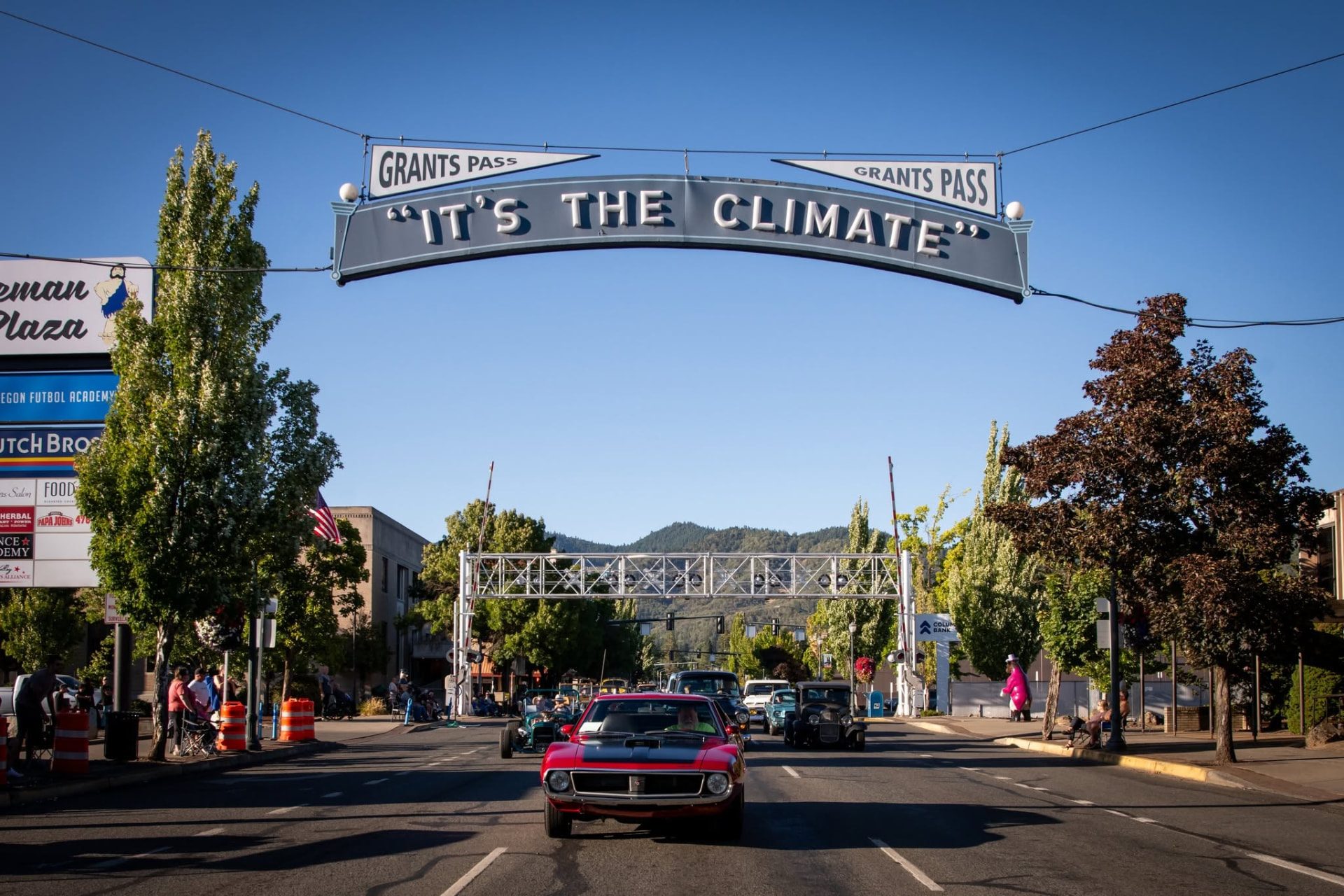
- Back to the 50s & Cruise the Rogue: Every July, classic car owners from across the Pacific Northwest gather for a week of car shows, sock hops, and evening cruises along 6th and 7th Streets (Cruise the Rogue).
- Art Along the Rogue: Each October, street-painting chalk artists transform 5th and H Streets in the Historic District into open-air murals (City of Grants Pass).
- Holiday Cocoa Crawl & Parade: In late fall and December, downtown merchants host seasonal tastings and holiday festivities organized through the local business community.
Transportation, Commuting, and Travel
Grants Pass sits directly on Interstate 5 at the junction of Highway 199 (the Redwood Highway to Crescent City and the Northern California coast), making it the main gateway between the Rogue Valley and the coast.
- Driving & Commuting: Medford is roughly 30 minutes south on I-5, making it realistic for residents who work at regional hospitals or commute to Jackson County while enjoying Josephine County home prices.
- Air Travel: Rogue Valley International–Medford Airport (MFR) is about a 30-minute drive from Grants Pass, offering daily connections to West Coast hubs without the hassle of big-city airport parking.
- Public Transit: Josephine Community Transit (JCT) operates fixed bus routes inside Grants Pass, Dial-A-Ride service, and the Route 100 Rogue Valley Commuter Line connecting Grants Pass to Medford via Rogue River and Gold Hill.
Four-Season Reality Check
Locals love the climate here, with two honest caveats every newcomer should know:
- Summer Heat & Smoke: July and August routinely reach the 90s (with occasional 100°F+ days), and late summer can bring periods of wildfire smoke depending on regional conditions—making good home HVAC filtration and river mornings part of local life.
- Winter Fog & Mild Rain: Unlike high-desert Oregon, Grants Pass gets green, rainy winters and morning valley fog, with only occasional light snow on the valley floor.
Grants Pass questions
Does buying a home in Grants Pass reset the property tax?
No. Under Oregon's Measures 5 and 50, assessed value grows by up to 3% a year unless major improvements are added, and it does not reset to your purchase price. Check the exact tax history on Josephine County Public Access.
Who provides fire protection outside Grants Pass city limits?
Inside city limits, the city fire department and hydrants are funded by city taxes. In unincorporated Josephine County, fire protection is a subscription membership through Rural Metro Fire or the Mid Rogue Fire District.
How far is the Medford airport from Grants Pass?
Rogue Valley International–Medford Airport (MFR) is about a 30-minute drive from Grants Pass.
Is there a bus from Grants Pass to Medford?
Yes. Josephine Community Transit runs fixed routes in Grants Pass and Dial-A-Ride, and the Route 100 Rogue Valley Commuter Line connects Grants Pass to Medford via Rogue River and Gold Hill.
Thinking about making Grants Pass home?
School information: Grants Pass School District 7 and Three Rivers School District.