Rural Property
Five things to check before you buy rural property in Southern Oregon
16 min read · Published October 29, 2026 · Last updated October 29, 2026
Fall for the view. Then read the well log.
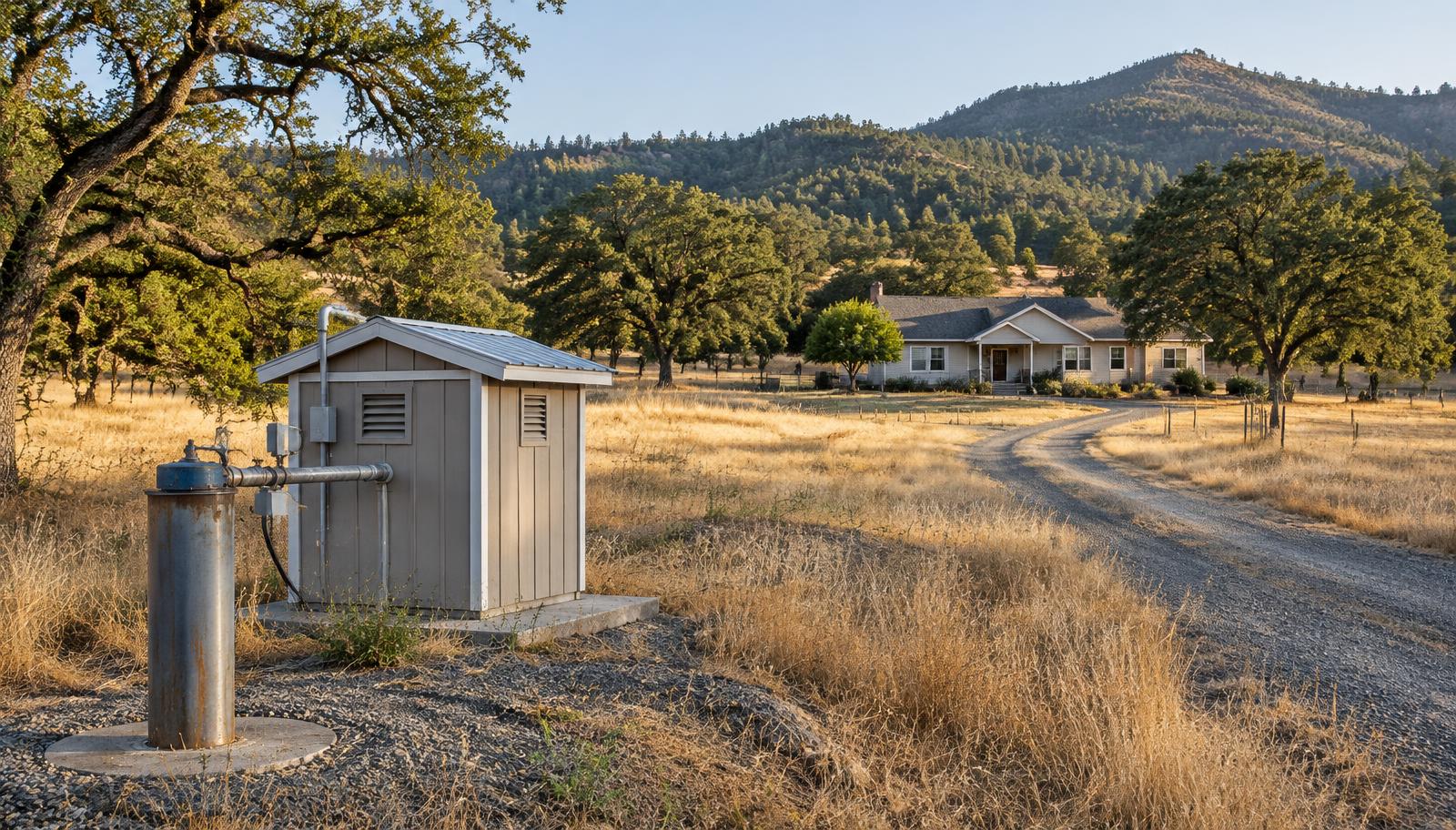
Rural property in Josephine and Jackson Counties runs on systems a city lot never asks you to think about. Your water comes out of the ground. Your wastewater goes back into it. Your fire protection might be a subscription. And the county may not maintain the road to your gate.
None of that is a reason to pass on land. It is a reason to check five things before your inspection period ends, while a problem is still something you can negotiate.
Below is what to ask for, where to look it up, and what the answers mean. Every rule links to the Oregon agency or statute it comes from, so you can check the work yourself.
The well
Ask for three things: the well report, a recent flow test, and the water test results the seller is required to order.
Start with the well report
Since 1955, Oregon has required licensed drillers to file a report with the Oregon Water Resources Department (OWRD) for every well drilled, modified, or abandoned (OHA Well Report Fact Sheet). The report shows how the well was built, how deep it goes, the static water level, the driller's description of the ground it passes through, and a yield test.
You can look it up for free with OWRD's Well Report Query tool by address or by township, range, and section. Wells drilled since 1996 carry a permanent metal tag with a unique number that ties that hole in the ground to its report (OHA). If you can't find a report, the regional watermaster can help you search.
Read the yield as a snapshot
The yield on a well report is the result of a test run when the well was drilled, and most of those tests last one hour (OHA). On an older property, that number may be decades old and taken in a different season. It tells you what the well did on one day. It doesn't tell you what it does in late August with a household, a garden, and the animals on it.
Ask for a current flow test
Oregon has no statewide flow-test requirement for a sale, though your lender may have one (OSU Well Water Program). The standard seller's disclosure statement asks whether a flow test was done in the past 12 months (ORS 105.464). If the answer is no, build one into your inspections and ask the well contractor what the result means for the household and the plans you actually have.
The water test is the seller's job, and it can't be waived
Under Oregon's Domestic Well Testing Act (ORS 448.271), the seller of a property with a domestic well has the water tested for arsenic, nitrate, and total coliform bacteria during the sale (Oregon Health Authority). A few things buyers don't expect:
- You can't waive it. OHA's rules say the tests are required even if the buyer agrees not to have the well tested (OAR 333-061, OHA).
- An accredited lab has to run it. Results are good for one year, so a seller can reuse them across offers inside that window (OHA).
- The seller has 90 days to send the results to the buyer and to OHA (OHA). Ninety days can be longer than your escrow, so ask for the results before your inspection period ends.
- The law requires the test, not a passing result (OSU Well Water Program). A high reading becomes a conversation about treatment and price. It doesn't stop the sale on its own.
- Not every well is covered. Spring sources, irrigation-only wells, and wells on undeveloped land are exempt (OHA). Buying bare land with a capped well? No test is required, so ask for one anyway.
Ask the seller for
- The well report, or at least the well tag number
- Any flow test from the last 12 months
- Lab results for arsenic, nitrate, and total coliform bacteria
- Whether there is a water treatment system, and whether it is owned or leased (the disclosure form asks both, per ORS 105.464)
Water rights
A domestic well gives you household water. It does not automatically give you irrigated pasture, an orchard, or a large garden.
What a well covers on its own
Under Oregon law, all water in the state belongs to the public, and most uses need a permit or water right from OWRD (OWRD, Exempt Water Uses in Oregon). Groundwater uses that are exempt from that permit process include (OWRD):
- Household (domestic) use up to 15,000 gallons per day
- Stock watering
- Watering a lawn or noncommercial garden of half an acre or less
- Since January 1, 2026, a commercial garden of half an acre or less using no more than 3,000 gallons per day
OWRD is direct about the limit: irrigating more than half an acre needs a water use authorization and is not exempt (OWRD).
Source: OWRD, Exempt Water Uses in Oregon
So a listing that says "water rights" on a property where the ditch hasn't run in years deserves a closer look. The seller's disclosure statement asks two useful questions: has the irrigation water been used in the last five years, and is there a certificate or other written evidence (ORS 105.464). Get both answers in writing.
Where to check
- OWRD's Water Rights Information System (WRIS) holds records of water right applications, permits, certificates, transfers, and leases (OWRD).
- OWRD's Water Rights Mapping Tool is a good first look, but OWRD says its map is approximate, some areas run as much as 15 years out of date, and it does not show irrigation district rights (OWRD disclaimer).
- The irrigation district, if the property sits inside one. Being inside a district doesn't guarantee the parcel has a water right (OSU Extension, EC 1650), so ask the district directly what this parcel is entitled to.
- The local watermaster. OWRD's watermasters help people work out how water law applies to a specific property (OWRD).
Septic
In Josephine and Jackson Counties, the state runs the septic program directly. The Oregon Department of Environmental Quality (DEQ) permits residential septic systems in Curry, Jackson, and Josephine Counties out of its Medford office (DEQ), and it keeps the records for all three counties (DEQ, Onsite Records).
Pull the record
DEQ files septic records by parcel number: township, range, section, quarter section, and tax lot. The county assessor can give you that number, and you can search the records online (DEQ). The county file can often include a map showing where the system sits on the property (OSU Well Water Program). That map matters when you're planning a shop, a barn, or a driveway.
Read the disclosure closely
Oregon's seller's disclosure statement asks more about septic than most buyers notice (ORS 105.464):
- When was the system installed, and was it installed under a permit?
- Has it been repaired or altered?
- Has it been evaluated, with a report issued?
- Has the tank ever been pumped, and when?
- Does it have a pump, or a treatment unit like a sand filter or aerobic unit?
- Is a service contract required for routine maintenance?
- Are all components of the system located on the property?
Pumps, treatment units, and service contracts mean ongoing cost and upkeep. A "no" on that last question means part of the system sits on someone else's land, and that deserves a long conversation before you go further.
Get it evaluated
Oregon doesn't require a septic evaluation to sell. DEQ still recommends one when you're buying or selling, and if an evaluation is done, the evaluator has to use DEQ's approved Existing System Evaluation Report form (DEQ, Oregon Septic Smart).
DEQ requires the evaluator to be an installer, a maintenance provider, a wastewater specialist, an environmental health specialist, or a NAWT-certified inspector with experience on existing systems. DEQ also publishes a SepticSmart inspector list as a starting point (DEQ). Check references.
One more thing: a freshly pumped tank doesn't mean a healthy drainfield. Pumping removes solids from the tank. It doesn't repair a drainfield that years of skipped pumping have already damaged (OSU Well Water Program). Ask for the pumping history, not just the last receipt.
If you plan to add a bedroom or replace the house
Adding bedrooms, replacing a house or manufactured home, or reconnecting to a system that hasn't been in use all go through DEQ's authorization notice process (DEQ Site Evaluation Packet). An onsite specialist confirms the existing system works and can handle the change. In some cases DEQ also requires a full replacement area to be set aside (DEQ). If a bigger house is the plan, find out whether the system can carry it before you own it.
Fire
Get a real homeowners insurance quote before your inspection period ends, not the week before closing.
Why the quote comes first
Every homeowners policy sold in Oregon has to include wildfire coverage (Oregon Division of Financial Regulation). The real question is whether a company will write the policy and at what price. Insurers use their own proprietary wildfire risk models, and any company can decide a particular property is too risky to cover (DFR).
If no standard company will cover the home, the Oregon FAIR Plan is the insurer of last resort. It writes a basic property policy at actual cash value (DFR), and its residential limit is $600,000 (DFR, SB 85 report). DFR notes that a wrap-around policy may be available to add liability and other coverage on top (DFR). If the house would cost more than that limit to rebuild, you want to know now.
The state map is gone. The risk models aren't.
In 2025 the Legislature passed Senate Bill 83, which repealed Oregon's statewide wildfire hazard map along with the building-code and defensible-space rules tied to it (SB 83, Oregon Legislature; Ballard Spahr summary). Even before the repeal, a 2023 law limited insurers' use of the state map in pricing and coverage decisions (DFR, SB 85 report; Oregon Legislature staff summary). Insurers price wildfire risk with their own models (DFR), and the repeal didn't take those away.
Ask the seller about insurance notices
Under Senate Bill 82 (2023), an insurer that cancels, non-renews, or raises a premium because of wildfire risk has to notify the homeowner. The notice has to include property-specific wildfire risk information, mitigation steps that could improve insurability, potential discounts, and the property's wildfire risk classification (Oregon Legislature staff summary). If the seller has received one of those notices, it tells you what an insurer already thinks of the property. Ask.
Know who answers the call
In much of rural Josephine County, structural fire protection works differently than in town. The Mid Rogue Fire District, formed in November 2024, doesn't collect taxes. Residents are covered through the district's service agreement with Rural Metro Fire, which means they need to keep a Rural Metro subscription (Mid Rogue Fire District). The district points residents to the Josephine County Fire Districts Map to check an address (Mid Rogue Fire District).
Around Grants Pass, many properties outside city limits sit in the Mid Rogue Fire District, formed in late 2024. The district doesn't yet collect taxes for fire service, so emergency response still comes through a Rural Metro Fire subscription. Ask whether the property is in a district and whether the subscription is current.
For any rural address, ask three questions: which agency responds here, is a subscription required, and is it current. Then ask your insurance agent how the answer affects your quote.
If you run into trouble finding coverage, DFR's consumer advocates help for free at 888-877-4894 (DFR).
Access
Know who maintains the road, and what the paperwork says about it.
Three kinds of road, three answers
| Road type | What it is | Who maintains it |
|---|---|---|
| County road | A public road the county has formally designated as a county road (ORS 368.001) | The county |
| Local access road | A public road that is not a county road, state highway, or federal road (ORS 368.001) | Usually the people who use it. The county isn't liable for failing to improve or repair it, and can spend county money on it only in an emergency or after a formal board order (ORS 368.031) |
| Private road | A road owned by private property owners and not dedicated to the public (ORS 105.175) | The people who hold easements over it, under ORS 105.175 (below) |
The middle row surprises people. A road can be public, open to anyone, and still be yours and your neighbors' to grade and gravel. Statewide, ORS 105.175 puts the upkeep of a shared easement on the people who use it. To learn the status of a specific road here, call Josephine County Public Works or Jackson County Public Works before you write an offer.
On a private road, the default is "you pay your share"
Oregon law says everyone who holds an interest in an easement has to keep it in repair (ORS 105.175). The costs are split under any maintenance agreement or the recorded document that created the easement. That agreement, or a memorandum of it, is supposed to be recorded with the county (ORS 105.175).
With no agreement, the law splits costs in proportion to each holder's use. How often you drive it counts, and so does the size and weight of your vehicles. Anyone who damages the road through negligence or abnormal use fixes it at their own expense (ORS 105.175). If you plan to build, remember that concrete trucks and a well rig count as use.
What to ask for
- The recorded easement for any part of the route that crosses someone else's land. Your title company can show you what is recorded. Make sure the road you actually drive matches it.
- The road maintenance agreement, if there is one. The seller's disclosure statement asks about easements, access limitations, and joint maintenance agreements (ORS 105.464).
- The road's status from the county: county road, local access road, or private.
- A conversation with the neighbors who share the road. Ask how upkeep has been handled and what it has cost. You'll learn more in ten minutes at a mailbox than from any document.
The five checks on one page
| Check | Ask the seller for | Verify it yourself at |
|---|---|---|
| The well | Well report or tag number, flow test from the last 12 months, arsenic/nitrate/coliform results | OWRD Well Report Query |
| Water rights | Water right certificate, proof of use in the last five years | OWRD WRIS, the irrigation district, the local watermaster |
| Septic | Permit record, pumping history, any evaluation report | DEQ septic records by parcel number |
| Fire | Any insurance non-renewal or wildfire notice, fire subscription status | Your insurance agent, the Mid Rogue Fire District or local fire agency |
| Access | Recorded easements, road maintenance agreement | Your title company, Josephine or Jackson County Public Works |
Before you write the offer
Rural land rewards the buyer who asks the dull questions early. A well log, a septic record, an insurance quote, and a road agreement are all cheap to get and easy to read.
The best time to find out is while it's still the seller's well.
If you're looking at rural property in Josephine or Jackson County, I'm glad to pull the well report and septic record with you before you write an offer. Call or text 541-218-7762, or email mocoyne@michaelocoyne.com.
Michael O'Coyne is an Oregon real estate broker with RE/MAX Integrity in Grants Pass, working with buyers and sellers across Josephine and Jackson Counties.
This post is general information, current as of October 29, 2026. It isn't legal, tax, or insurance advice. Rules change, so confirm the details for a specific property with the agency linked above, an attorney, or your insurance agent.
Sources
Wells
- Oregon Health Authority, Well Testing & Regulations
- Oregon Health Authority, Domestic Well Testing rules, OAR 333-061-0305 to -0335
- Oregon Health Authority, Water Well Report Fact Sheet
- Oregon Water Resources Department, Well Report Query
- ORS 448.271, Domestic Well Testing Act
- Oregon State University Well Water Program, Real Estate Sales
Water rights
- Oregon Water Resources Department, Exempt Water Uses in Oregon
- Oregon Water Resources Department, Cancellation of Water Rights
- Oregon Water Resources Department, Water Rights Information System
- Oregon Water Resources Department, Water Rights Mapping Tool disclaimer
- OSU Extension, Living on the Land: Using Irrigation Water Legally (EC 1650)
Septic
- Oregon DEQ, Residential Septic Permitting
- Oregon DEQ, Locating Onsite Septic System Records Online
- Oregon DEQ, Oregon Septic Smart
- Oregon DEQ, Site Evaluation Packet
Fire and insurance
- Oregon Division of Financial Regulation, Homeowners insurance and wildfires
- Oregon Division of Financial Regulation, SB 85 report (2025)
- Oregon Division of Financial Regulation, Wildfire emergency order extension, Aug. 28, 2026
- Oregon Legislature, SB 83 (2025) and SB 85 staff measure summary
- Ballard Spahr, Oregon Repeals Statewide Wildfire Hazard Map and Mitigation Requirements
- Mid Rogue Fire District
Access and disclosure
- ORS 368.001 and ORS 368.031, county roads and local access roads
- ORS 105.175, easement maintenance and cost sharing
- ORS 105.464, seller's property disclosure statement
- Washington County, Types of Roads
Common questions
Does Oregon require a septic inspection when a home sells?
No. Septic evaluations are voluntary in Oregon, though DEQ recommends one when you buy or sell, and any evaluation has to use DEQ's approved form.
Does Oregon require well testing when a home sells?
Yes, for a domestic well. The seller has the water tested for arsenic, nitrate, and total coliform bacteria, and sends the results to the buyer and the Oregon Health Authority within 90 days. The buyer can't waive it.
Can I irrigate pasture from my house well?
Only up to a point. Watering a lawn or noncommercial garden of half an acre or less is exempt. Irrigating more than that needs a water right.
Does Oregon still have a statewide wildfire hazard map?
No. Senate Bill 83 repealed it in 2025. Insurers still price wildfire risk with their own models.
Who pays to keep up a shared private road?
The people who hold an interest in the easement. Costs follow any recorded agreement. Without one, they're split in proportion to each holder's use.